Nazca Lines: Human Art or Ancient Astronauts? (photos & video)
Deep in the arid desert plains of southern Peru lies one of the world’s most intriguing archaeological wonders: the Nazca Lines. Spread across more than 450 square kilometers, these enormous geoglyphs depict animals, humans, plants, geometric forms, and long, ruler-straight lines that stretch for kilometers. Their sheer scale and precision have fascinated archaeologists, historians, travelers — and even UFO researchers — for nearly a century.
What Are the Nazca Lines?
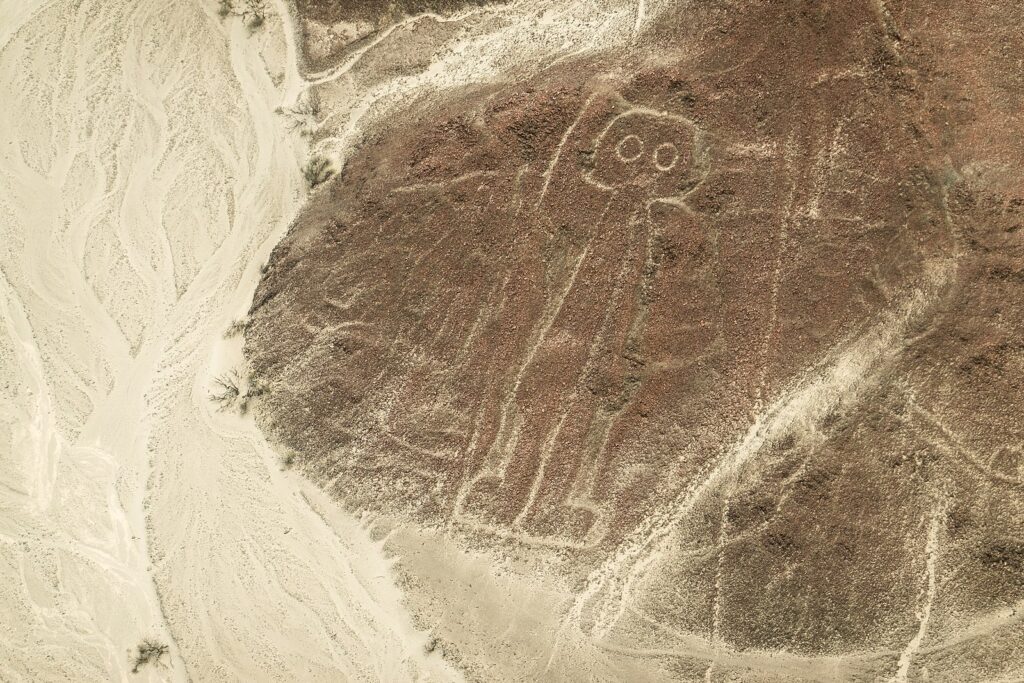
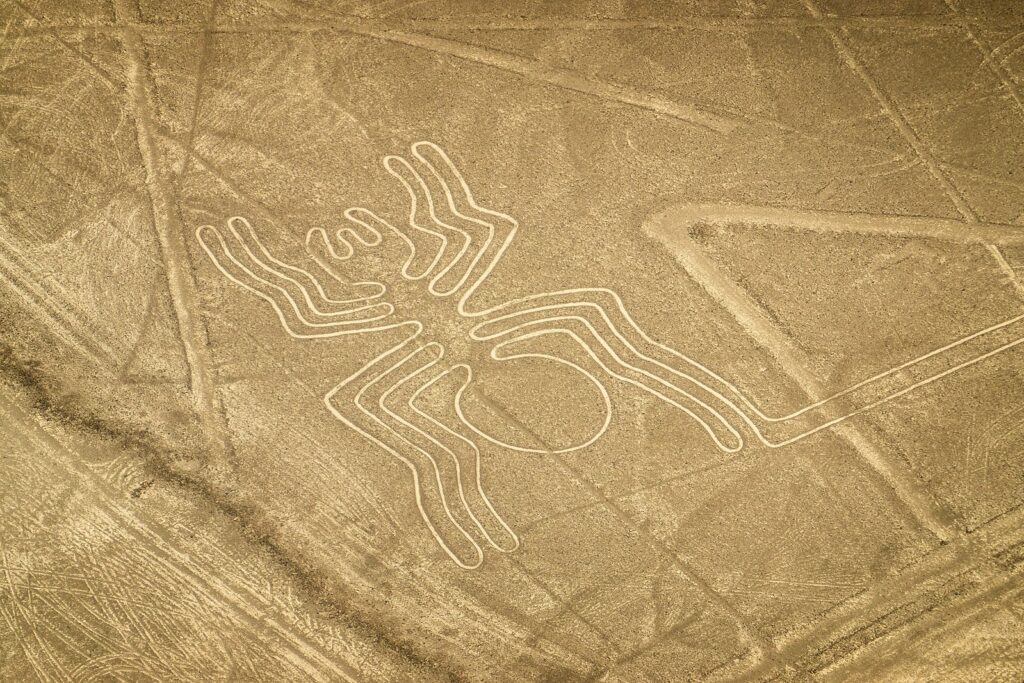
The Nazca Lines are a collection of hundreds of giant drawings etched into the desert floor. Some figures measure more than 300 meters long, and many are so large that they can only be fully seen from the air. The most famous geoglyphs include the Hummingbird, Spider, Monkey, Condor, and Astronaut, along with long parallel lines and geometric shapes like spirals and trapezoids.
These designs were created by removing the top layer of reddish pebbles, exposing the lighter soil beneath — a technique simple in concept but extraordinary in execution.
Where They Are Located
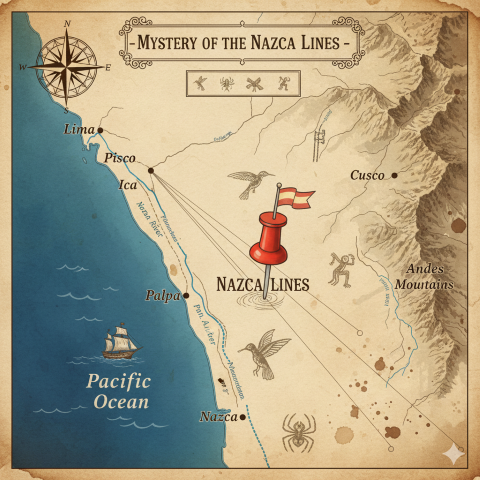
The lines are found in the Nazca Desert, a dry plateau between the towns of Nazca and Palpa in the Ica region of Peru. This region is one of the driest places on Earth, receiving less than 2 cm of rainfall per year. The extreme dryness and stable climate have helped preserve the lines for over a millennium.
When Were They Discovered?
While local populations likely always knew of their existence, the Nazca Lines gained global attention only in the 1920s, when commercial aircraft began flying over Peru. Pilots noticed the huge drawings and reported them, leading to scientific investigations.
By the 1930s and 1940s, researchers like Paul Kosok and later Maria Reiche, a German mathematician, began systematic studies. Reiche spent decades mapping, measuring, and protecting the geoglyphs, earning the nickname “The Lady of the Lines.”
When and Why Were They Created?
Most archaeologists believe the Nazca Lines were created between 500 BCE and 500 CE by the Nazca culture, a pre-Inca civilization known for its pottery, textiles, and advanced understanding of irrigation and astronomy.
The purpose of the geoglyphs remains a topic of debate, but several theories have emerged:
- Astronomical Calendar: Early researchers suggested the lines aligned with solstices, constellations, and celestial events.
- Ritual Paths: Some believe the long straight lines were ceremonial walkways used during religious processions.
- Water Worship: Since water was vital for survival, certain shapes may have been offerings to deities that controlled rain and fertility.
- Sacred Art: The images may have represented deities, animals, or mythological symbols important to the Nazca religion.
While none of these theories are universally accepted, most scholars agree the lines had spiritual and ritual significance.
Why Some Believe the Nazca Lines Are Connected to Extraterrestrials
Because the geoglyphs are so massive and visible primarily from the sky, they have become a central subject in ancient-astronaut theories. UFO researchers and authors like Erich von Däniken argue that:
- The lines appear like runways, suggesting landing paths for extraterrestrial craft.
- The precision and size seem beyond the capabilities of an ancient civilization without aerial technology.
- The “Astronaut” geoglyph, depicting a humanoid figure with a large head and raised hand, resembles extraterrestrial imagery found in popular culture.
- The Nazca people’s astronomical knowledge implies contact with higher, possibly nonhuman intelligence.
Mainstream archaeology strongly disputes these claims, pointing out that the Nazca culture had the tools, organization, and mathematical understanding necessary to construct the geoglyphs. However, the alien hypothesis remains popular because it taps into the mystery of how ancient humans achieved such a feat without modern technology.
An Enduring Mystery that Continues to Attract the World
Whether spiritual symbols, astronomical guides, ritual paths, or something more mysterious, the Nazca Lines continue to captivate researchers and visitors alike. Their immense scale and the secrets they hold make them one of humanity’s most fascinating creations.
From archaeological theories to extraterrestrial speculation, the Nazca Lines remain a doorway into ancient imagination — and perhaps, to possibilities beyond our planet.

