Mysterious Flashes on the Moon: What is their cause?
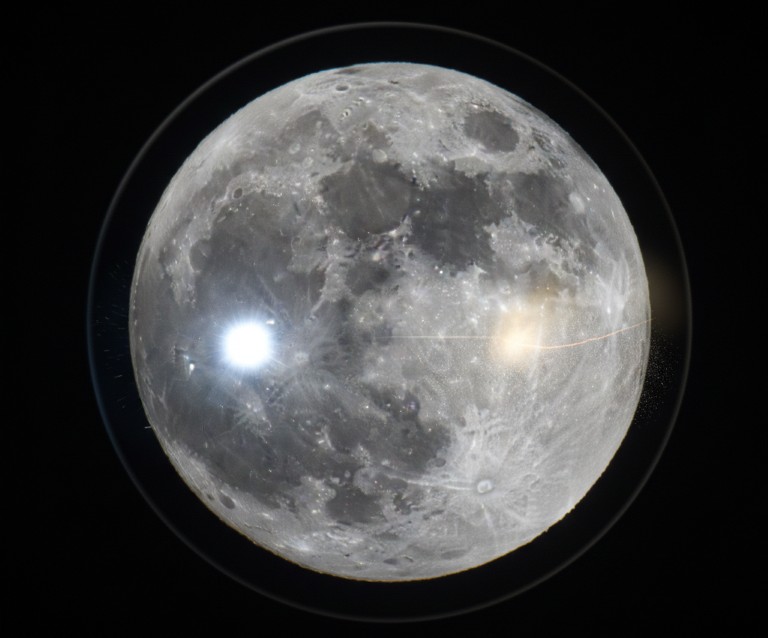
Mysterious lights occasionally appear on the Moon, ranging from brief flashes lasting a few seconds to bright spots that persist for hours. Scientists explain that these “Transient Lunar Phenomena” (TLPs) may be caused by meteorite impacts, gas releases, or even clouds of lunar dust, offering valuable clues about the dynamics and activity of our natural satellite.
For centuries, humans have been fascinated by sudden flashes, bright spots, and rays of light on the Moon. From William Herschel’s observation in 1787, when he saw a flash as bright as the constellation Orion, to modern recordings with telescopes, the so-called “Transient Lunar Phenomena” (TLPs) continue to spark the interest of astronomers and sky observers.
What are Transient Lunar Phenomena?
TLPs are short-term changes in the appearance of the lunar surface. They can manifest as bright flashes, reddish or purplish spots, or even hazy patches. To date, approximately 3,000 incidents have been recorded, lasting from milliseconds to hours.
Short Flashes: Meteorite Impact
The briefest flashes, lasting less than a minute, are usually caused by meteorite impacts. When cosmic bodies weighing about 0.2 kilograms strike the Moon, the collision energy heats the surface, creating a bright flash. Such “Lunar Impact Flashes” (LIFs) were confirmed in the 1990s using high-speed video cameras, and programs like the European NELIOTA have recorded hundreds of such incidents.
Longer Flashes: Gas Release and Moonquakes
TLPs lasting a few minutes may be due to the release of radon gas from the lunar subsurface. Studies suggest that trapped gases, activated by moonquakes, are explosively released and emit light as the radon radioactively decays. This may explain why certain areas exhibit longer-lasting flashes.
Flashes Lasting Hours: Dust and Solar Wind
Some of the most mysterious phenomena, such as those observed by Herschel, can last for hours. Research indicates that the solar wind—a stream of charged particles from the Sun—can lift lunar dust into massive clouds up to 100 kilometers high. These clouds can refract light from stars or other bright objects, creating the illusion of a bright surface.