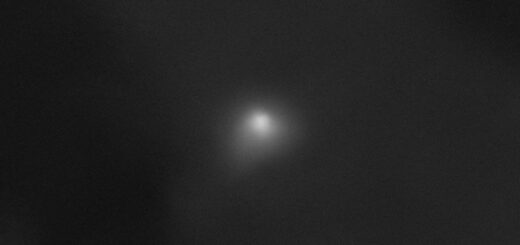
Is Interstellar Object 3I/ATLAS an Alien Probe?

The cosmos continues to surprise us, and the recent discovery of interstellar object 3I/ATLAS has certainly stirred the pot. First detected on January 6, 2024, by the ATLAS survey in Hawaii, this intriguing visitor from beyond our solar system has sparked a flurry of speculation, with some even daring to suggest an artificial, alien origin. While the scientific community remains cautious, the sheer oddity of 3I/ATLAS makes it a compelling subject for discussion.
A Close Encounter? Pinpointing 3I/ATLAS’s Proximity
One of the most pressing questions surrounding 3I/ATLAS is its proximity to Earth. Initially, astronomers calculated a relatively close approach, fueling excitement about potential observation opportunities. However, as more data has been collected over the past week, these estimations have been refined. Current projections place its closest approach to Earth somewhere in late February to early March 2025, at a distance of approximately 0.4 AU (Astronomical Units), which is about 60 million kilometers or 37 million miles. While this might seem like a vast distance, it’s significantly closer than most interstellar objects and will offer a prime viewing window for powerful telescopes. This proximity allows for detailed observations, which are crucial for understanding its true nature.
The “Artificial” Hypothesis: Why the Buzz?
The reason for the “alien probe” speculation stems from several unusual characteristics observed in 3I/ATLAS. Unlike typical comets or asteroids, its light curve has shown peculiar fluctuations and an unexpected lack of a distinct cometary tail, even as it approaches the sun. Some preliminary analyses of its rotational period and light variations have led to suggestions of an elongated, perhaps even geometric, shape. These anomalies, while not definitive proof of alien technology, are enough to prompt comparisons to ‘Oumuamua, another interstellar object that briefly ignited similar debates due to its inexplicable cigar-like shape and non-gravitational acceleration.
Recent Developments and Ongoing Research
In the past week, astronomers worldwide have been scrambling to gather as much data as possible on 3I/ATLAS. Several observatories have dedicated telescope time to track its trajectory and analyze its spectral signature. Preliminary spectroscopic data released suggests a composition that is not immediately identifiable with known solar system bodies, further adding to the enigma. Researchers are particularly interested in any signs of outgassing or changes in its rotation, which could provide clues about its internal structure and potential activity. The focus is on ruling out natural explanations before any more exotic theories gain significant traction.
What Does the Future Hold for 3I/ATLAS?
As 3I/ATLAS continues its journey through our solar system, the scientific community will be diligently working to unravel its mysteries. Future observations, especially during its closest approach, will be critical. Space-based telescopes, free from atmospheric interference, will offer unparalleled views, potentially revealing details about its surface features, composition, and even its internal structure. While the notion of an alien probe remains firmly in the realm of speculation, 3I/ATLAS serves as a powerful reminder of the vast unknowns that lie beyond our planetary neighborhood and the endless possibilities that await discovery.