🛸3I/ATLAS: Alien Ship or Ancient Comet? An Interstellar Mystery (video)
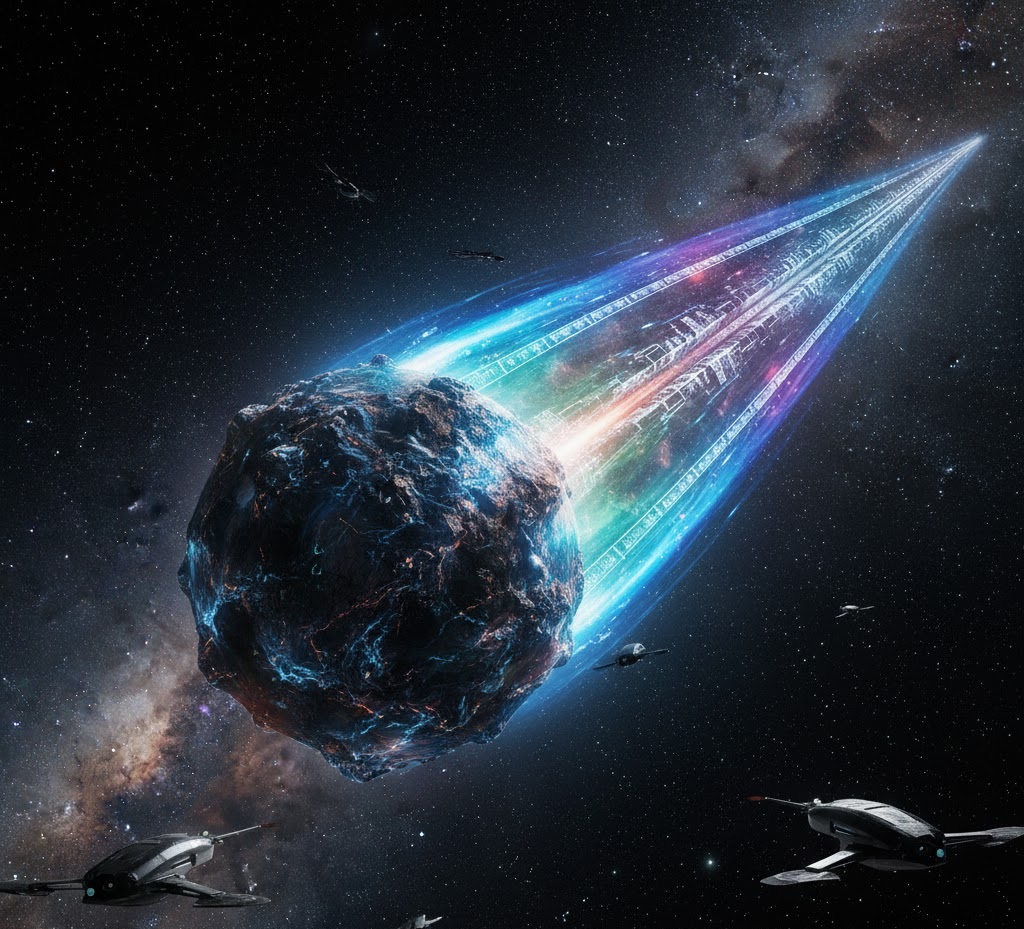
When the object now designated 3I/ATLAS was first detected in July 2025, astronomers were excited but cautious: this was only the third confirmed interstellar wanderer ever seen entering our solar system. At first glance it seemed to fit the “comet” category—an icy remnant arriving from another star system. But as observations piled up, the picture became far stranger. The latest updates are forcing a reconsideration: could this visitor be more than a natural comet? Could it in fact be an alien spacecraft or technology?
One of the more puzzling developments is its chemical composition. Observations from missions such as the James Webb Space Telescope (JWST) and NASA’s SPHEREx reveal that 3I/ATLAS is surrounded by a cloud dominated by carbon dioxide (CO₂), with little detectable water vapor (H₂O)—the reverse of what a typical comet from our solar system produces. Furthermore, some spectroscopic data hint at nickel emissions without the expected iron content in the gas plume—an anomaly that some interpret as pointing to industrial rather than purely natural chemistry. The nature of these observations raises the question: is this object being powered or maintained in some way?
Additionally, 3I/ATLAS’s behavior is odd even for an interstellar visitor. Its orbit is hyperbolic—clearly unbound to the Sun—so it’s guaranteed to depart the solar system forever. But beyond that, its activity appears out of sync with expectations: unusually fast brightening, a coma and tail structure that defy typical patterns, and the possibility of jets directed in ways not simply explained by solar heating alone. Some researchers, including astrophysicist Avi Loeb, have even speculated—though admittedly tentatively—that perhaps we should entertain the idea of “alien origin,” or at least non-standard origin.
Most scientists still lean toward the natural comet explanation, reasoning that exotic chemistry can still arise from unusual conditions in interstellar space. But the sheer number of anomalies means that dismissing the “alien spacecraft” hypothesis out of hand may be premature. After all, if this object is indeed artificial, the implications would be profound. And at the very least it serves as a reminder that nature is capable of far more variation than our textbook examples suggest.
As 3I/ATLAS recedes back into interstellar space—after its closest approach to the Sun around October 2025 and its return to visibility in early December 2025—astronomers will continue to watch and gather data. Whether it turns out to be a spaceship, a weird comet, or something in between, its passing offers one of the rarest scientific opportunities of our time: a direct visit from beyond our solar system, with secrets that may challenge our understanding of what visits from the stars can look like.